Honouring Strength, Healing with Respect
Walking Together in Healing
Prostate cancer affects Indigenous men in Canada and Aotearoa New Zealand at increasing rates — yet access to timely diagnosis, culturally safe support, and empowering education remains limited.
Historical trauma, systemic racism, and gaps in culturally grounded care continue to shape Indigenous men’s experiences with cancer and survivorship.
At PC-PEP, we walk alongside Indigenous men, families, and communities — not ahead, not behind.
We recognize that true healing honours the whole person: body, mind, spirit, and connection to the land.
Our goal is to support strength, dignity, and wellness through approaches that respect traditional knowledge, community leadership, and self-determination.

Barriers to Care
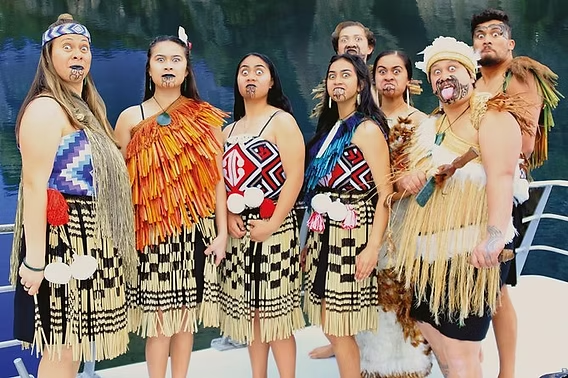
Across Mi’kma’ki, the Prairies, the North, and the Māori heartlands, Indigenous men face many of the same barriers — but within distinct cultural and historical contexts.
Mistrust of the Healthcare System
Colonization, medical racism, and past injustices have created understandable hesitation and mistrust toward formal health systems.
Geographic Isolation
Remote and northern communities often lack local urologists, reliable transportation, or regular screening opportunities — leading to later diagnoses.
Cultural Disconnect
Western medicine often focuses on disease rather than wellness. It can overlook Indigenous ways of knowing, spiritual practices, and the importance of family and community healing.
Silence Around Men’s Health
Cultural expectations of strength and stoicism can make it difficult to talk about topics like incontinence, sexual health, or emotional well-being.
How PC-PEP Is Walking With Indigenous Communities
PC-PEP is a free, evidence-based, six-month home program that can be accessed from anywhere.
It supports healing across physical, emotional, mental, and spiritual dimensions through daily guidance videos, email support, and monthly gatherings.
Together with Indigenous men, Elders, and health leaders, we are:
- Ensuring cultural safety and trauma-informed design — guided by Indigenous clinicians, researchers, and advisors in Canada and Aotearoa New Zealand.
- Offering pre-session groups created specifically for Indigenous participants, led in partnership with community facilitators.
- Integrating storytelling and oral traditions into podcasts and educational materials.
- Collaborating with Māori and Canadian Indigenous researchers to localize PC-PEP content, language, and imagery.
- Encouraging whānau/family participation so that healing happens in relationship, not isolation.
Voices from the Community
- “This was the first time I felt like a health program truly respected where I come from.” — Elder, Mi’kmaq Territory, Canada
- “The teachings I carry helped me through cancer. PC-PEP added to that strength with structure, breathing, and balance.” — Leon, Cree Nation, Canada
- “We’re used to healing as a whānau, not alone. PC-PEP understands that healing is more than medicine.” — Tama, Māori Participant, Aotearoa New Zealand
- “This program was a gift. It gave me tools to take back my health—and now I’m helping others in my marae do the same.” — Wiremu, Māori Community Leader
Human Impact Story
Mike and Barb Hull, an Indigenous PC-PEP participant and his wife, have shared their journey with courage and honesty.
By speaking openly about prostate cancer, they are helping to rebuild trust, reduce stigma, and inspire other Indigenous men and families to seek help and healing.

Their story reflects the power of partnership — between patients, families, and communities — in reclaiming health and hope.

Healing Through Community, Not in Isolation
PC-PEP invites Indigenous men to reconnect with healing in ways that honour identity, culture, and tradition.
The program is flexible, adaptable, and welcomes integration with traditional medicine, ceremony, and community values.
Through this partnership, we aim to weave together Indigenous wisdom and Western science — strengthening both.
Episode 13 — Not Alone: Partnership and Presence in the Face of Cancer
Published: January 26, 2026
In this deeply personal and profoundly human episode of the PC-PEP Podcast, Dr. Gabriela Ilie sits down with Mike and his wife Barb for an honest, unguarded conversation about what it truly means to face prostate cancer together.
Mike is a member of the Native Council of Nova Scotia and serves on its Board of Directors. Together, he and Barb bring a deeply relational, grounded way of being to this conversation—one that reminds us we are not meant to walk hard things alone. Mike shares parts of his diagnostic and treatment journey — including the emotional uncertainty, waiting periods, and the impact of the disease on identity and daily life. Barb offers a powerful and grounded perspective on what it feels like to walk alongside the person you love through diagnosis, treatment, and the space beyond.
This episode marks the first time the podcast brings both the person diagnosed and their life partner into the conversation — not to represent a community or to give advice, but to illuminate the lived experience of partnership, presence, and connection in the face of serious illness.
Themes Explored in This Episode
- Receiving a prostate cancer diagnosis and living with uncertainty
- Navigating appointments, treatments, and emotional transitions
- How illness is experienced within a shared life
- The relational work of staying close when life changes
- Finding presence, routine, and community support beyond the clinic
- The role of trust, humour, and mutual care in staying grounded
Notable Takeaways
- Illness does not have to isolate us; presence and connection matter
- Partners are co-travellers — not spectators — in the cancer journey
- Support can come from intentional daily practices and shared life
- Lived experience, shared without pretense, brings others comfort and insight
Watch on YouTube:
Listen on Buzzsprout: https://www.buzzsprout.com/2420283/
Available on Apple Podcasts, Spotify, Google Podcasts, Podcast Addict, iHeartRadio, Player FM, and more.
This initiative is funded by Movember and delivered in partnership with PC-PEP at Dalhousie University.
How to Join PC-PEP?
If you are an Indigenous man with a prostate cancer diagnosis—or a health worker, Elder, or organization interested in bringing PC-PEP to your community—we would be honoured to connect.
👉 [Learn More & Register] – Enter your information in the contact form and a member of our team will connect with you the next business day.
👉 [Contact Us to Collaborate or Request a Community Presentation]


Next Steps
We are committed to long-term collaboration, not short-term consultation.
- Recruiting Indigenous participants from Canada and Aotearoa New Zealand to help guide program adaptation.
- Hosting culturally grounded stakeholder sessions with Elders, clinicians, and community organizations.
- Publishing co-created program adaptations by late 2026, ensuring PC-PEP reflects Indigenous knowledge systems and community priorities.
Healing the body. Strengthening the spirit. Walking together.
Supported by Movember
This initiative is proudly funded by Movember (January 2025 – January 2028) through a Health Equity Grantawarded to Drs. Gabriela Ilie and Rob Rutledge at Dalhousie University.
With Movember’s support, PC-PEP is working with Indigenous leaders, Elders, and researchers to ensure that every man — Mi’kmaq, Cree, Inuit, Métis, Māori, or otherwise — can access care that honours both science and spirit.
Together, we are building bridges between worlds of knowledge and creating a path forward where Indigenous men and families can thrive after prostate cancer.

 English (Canada)
  Français du Canada
  Română
  Nederlands (België)